As Venus climbed out of the tank her first thought was to share what she’d found with Adi and Jean and tell them her plan. Her subsequent thoughts were not so pleasant.
Ten minutes later:
to be continued ……
******************************
vegan, vegetarian, vegan comic, vegan comic for children, children’s story, vegan children, aquariums, animals, animals in captivity, animals for entertainment, marine animals, fish, crustaceans, art, comics, juvenile fiction, watercolour, adventure, children’s adventure story, vegan children’s story
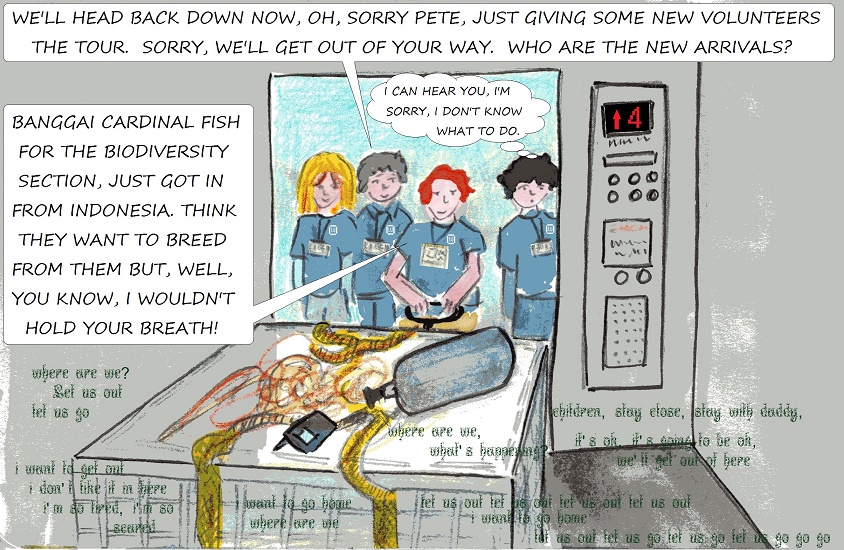
“Ok, well,” Carolyn smiled, “while we’re up here I want to show you the top of the tank where the divers, and the fish, go in.”
Venus could see and hear William’s distress. She could only imagine the misery he went through every time he was transported from Scotland to the south coast and back again. But she couldn’t help him. Carolyn was soon ushering them on.
When the fish container was pulled out of the lift, Carolyn, Katie and Venus descended to the viewing gallery:
to be continued ….
*****************************
vegan, vegetarian, vegan comic, vegan comic for children, children’s story, vegan children, aquariums, animals, animals in captivity, animals for entertainment, marine animals, fish, crustaceans, art, comics, juvenile fiction, watercolour
Oxford Dictionary definition: small edible sea fish.
Juvenile-whiting
Our definition: Whiting (Merlangius merlangus) fish are similar in appearance to their larger relatives, cod, haddock, coley and pollack. They have three dorsal fins separated by small gaps, the third fin extending almost to the tail fin. The tail is not forked, having almost a square end. The two anal fins are very close together, nearly touching one another and, together with the anterior fin, are elongated. The pectoral fin is also long and projects beyond the base of the anal fin. A whiting’s upper jaw projects slightly beyond the lower, and the lateral line is continuous along the length of the body. In colour, individual fish vary quite a lot, and there is often a small dark blotch at upper base of the pectoral fin. They can grow to up to 50 cm long.
Whiting matures at between three and four years of age, and spawning takes place at a depth of 20 to 150 m. The time of the spawning varies from location to location: from January to spring in the Mediterranean; from January to September in the area between the British Isles and the Bay of Biscay; and throughout the year in the Black Sea. A large female can produce up to one million eggs. The eggs float in the open ocean and the larval whiting swim with other sea plankton until they have attained a length of around 10 cm. The fish grow quickly, with females growing faster than males, and can live to about ten years of age. The diet of the whiting consists of bottom-living organisms, such as crabs, shrimps, small fish, molluscs, worms, squid and cuttlefish.
The biggest threat to whiting is “over-harvesting” (euphemism) by the fishing fleets of many nations (of course).
Oxford Dictionary definition: large edible fish yielding caviar.
Our definition: Sturgeons are native to subtropical, temperate and sub-Arctic rivers, lakes and coastlines of Eurasia and North America. They are distinctive for their elongated bodies, lack of scales, and occasional great size: sturgeons ranging from 7–12 feet (2-3½ m) in length are common, and some species grow up to 18 feet (5.5 m). Most sturgeons are anadromous (migrating up rivers to spawn) bottom-feeders, spawning upstream and feeding in river deltas and estuaries. While some are entirely freshwater, a very few venture into the open ocean beyond near coastal areas.
Sturgeon are primarily benthic feeders (feeding on the river bed or ocean floor), with a diet of shells, crustaceans and small fish. They feed by extending their syphon-like mouths to suck food from the benthos. Having no teeth, they are unable to seize prey, though larger individuals can swallow very large prey items, including whole salmon. Sturgeons feed non-visually. They are believed to use a combination of sensors, including olfactory sensors, tactile chemosensory cues on the 4 barbules, and passive electroreceptors (ampullae of Lorenzini).
Many sturgeon leap completely out the water, usually making a loud splash which can be heard half a mile away on the surface and probably further under water. It is not known why they do this, but suggested functions include group communication to maintain group cohesion, catching airborne prey, nuptial behaviour, or to help shed eggs during spawning. Other plausible explanations include escape from predators, shedding parasites, or to gulp or expel air. Another explanation is that it “simply feels good”.
Sturgeon can live 100 years and have been around since the dinosaurs. Because of their long reproductive cycles, long migrations, and sensitivity to environmental conditions, many species are under severe threat from overfishing, poaching, water pollution, and damming of rivers. There is also a noticeable decline in sturgeon populations as the demand for caviar increases (see Roe on the R page). According to the IUCN, over 85% of sturgeon species are classified as at risk of extinction, making them more critically endangered than any other group of species.
Our definition: The Atlantic mackerel (Scomber scombrus) is a beautifully streamlined, fast-swimming fish. It has silver underparts and metallic green and blue upper parts with irregular bands along the back.
Click the Mms for the rest of the M Words
And check out the Vegan Dictionary in the sidebar for words beginning with other letters, defined in a way that doesn’t normalise animal exploitation and degradation.






























































 Violet's Vegan Comics