Welcome to Story Time

Vegan Story Time #2: Where are you going Deidra?

Vegan Story Time #1: “I’m not dinner!”

‘The King’s Three Sons’ is here!

Another New Fairy Tale

Where’s Dolly?

E is for Elephant

E is for Elephant

Elephant    noun

Oxford Dictionary definition:  Largest living land animal with trunk and ivory tusks.

Our definition:  Elephants are large mammals of the family Elephantidae and the order Proboscidea.  Two species are traditionally recognised: the African elephant and the Asian elephant.  Male African elephants are the largest surviving terrestrial [land] animals and can reach a height of 4 metres and weigh 7,000 kg. All elephants have a long trunk, used for many purposes, particularly breathing, lifting water and grasping objects.  All African elephants, male and female, have tusks whereas only some Asian males have tusks. About 50% of Asian females have short tusks known as tushes – which have no pulp inside.  Usually in mammals tusks are enlarged canine teeth, but in elephants they are actually elongated incisors and are essentially no different from other teeth. One third of the tusk is actually hidden from view, embedded deep in the elephant’s head. This part of the tusk is a pulp cavity made up of tissue, blood and nerves. The visible, ivory part of the tusk is made of dentine with an outer layer of enamel.  Their tusks can serve as weapons and as tools for moving objects and digging. Elephants’ large ear flaps help to control their body temperature.  African elephants have larger ears and concave backs while Asian elephants have smaller ears and convex or level backs.

Elephants are herbivorous and can be found in different habitats including savannahs, forests, deserts and marshes. They prefer to stay near water. Females, known as cows, tend to live in family groups, which can consist of one female with her calves or several related females with offspring. The groups are led by an individual known as the matriarch, often the oldest cow. Elephants have a fission-fusion society in which multiple family groups come together to socialise. Males, known as bulls, leave their family groups when they reach puberty, and may live alone or with other males. Adult bulls mostly interact with family groups when looking for a mate. Calves are the centre of attention in their family groups and rely on their mothers for as long as three years. Elephants can live up to 70 years in the wild. They communicate by touch, sight, smell and sound; elephants use infrasound (low frequency sound), and seismic communication (sometimes called vibrational communication) over long distances. Elephant intelligence has been compared with that of primates and cetaceans. They have self-awareness and show empathy for dying or dead individuals of their kind.

African elephants are listed as vulnerable by the International Union for Conservation of Nature, while the Asian elephant is classed as endangered. One of the biggest threats to elephant populations is the ivory trade, as the animals are poached for their ivory tusks. Other threats to wild elephants include habitat destruction and conflicts with local people.

Horribly, in addition to murdering them for their ivory, human beings have exploited elephants for entertainment in zoos and circuses for centuries; and now the military thinks they might be useful for sniffing out bombs!

Thank goodness for The Elephant Sanctuary, Tennessee, a natural habitat refuge developed specifically for African and Asian elephants, which is home to beautiful animals, rescued or retired from zoos and circuses, who can now live out their lives in a safe haven dedicated to their well-being.

elephant sanctuary

Spider in my shower cap

Violet’s Veg*n E-Comics: For Small & Big Kids Alike!

We were so excited yesterday when we discovered, in our Reader, this brilliant post by Chrissy from Hold The Eggplant. Hold The Eggplant is all about navigating the vegan lifestyle, looking at fashion, food, travel, book reviews and all sorts, from a vegan perspective. We thank Chrissy from the bottom of our hearts for this enthusiastic review of our site.

chrissy's avatarHold the Eggplant

Veganism is growing by the day (hooray!), but it’s not just grown-ups who are embracing compassionate living; many children and young people are too! Whether raised from birth as vegans, or choosing to embrace compassionate living as young people, vegan numbers are growing and times are changing, and I for one couldn’t be happier about it.

Most of the information available for vegans centres on food and health; there are countless sites we can search for menu inspiration and recipes, and tips to eat better. Some of these sites are family friendly, but few tackle the process of what it actually means to grow up vegan. Sure, we grown-ups know that being vegan is the most life-affirming action we can take, but how does that translate for children and young people? What resources are available for them to tackle the complex terrain of living vegan in a non-vegan world?

This is what makes Violet’s Veg*n E-Comics

View original post 251 more words

Chickens Are People Just Like Dogs

Babs on a bike

1

 bike rides

 bike rides

 bike rides

 bike rides

 bike rides

 bike rides

The Sustrans website will tell you all about the National Cycle Network in the UK which “is a series of traffic-free paths and quiet, on-road cycling and walking routes, that connect to every major town and city.  The Network passes within a mile of half of all UK homes and stretches over 14,000 miles across the UK.”

They also have a shop where you can buy maps, books, clothes and accessories etc, although you might have a good cycle shop in your own neighbourhood where you can get everything you need; or, even better, check out the second hand shops and the shops of animal-friendly charities and re-use something someone else doesn’t need any more (for a fraction of the price).

bike riding

Hope for homeless old dog

Ban Fur From the Runways of Milan Fashion Week

Introducing Marcus

New Fairy Tale – Coming Soon!

D is for Donkey

D is for donkey

Donkey    noun

Oxford Dictionary definition:  1. Domestic ass  2. colloquial stupid person

Our definition:  The donkey’s wild ancestor, the African Wild Ass, is well suited to life in a desert or semi-desert environment, having a tough digestive system which can break down desert vegetation and extract moisture from food efficiently. They can also go without water for a fairly long time. Their large ears give them an excellent sense of hearing and help in cooling.  Because of the sparse vegetation in their environment wild asses live somewhat separated from each other (except for mothers and young), unlike the tightly grouped herds of wild horses. They have very loud voices, which can be heard for over 3 km (1.9 mi), which helps them to keep in contact with other asses over the wide spaces of the desert.

Mature males defend large territories around 23 square kilometres in size, marking them with dung heaps – an essential marker in the flat, monotonous terrain.  Due to the size of these ranges, the dominant male cannot exclude other males. Rather, intruders are tolerated—recognized and treated as subordinates, and kept as far away as possible from any of the resident females.

Wild asses can run swiftly, almost as fast as a horse.  However, their tendency is to not flee right away from a potentially dangerous situation, but to investigate first before deciding what to do.  When they need to, they can defend themselves with kicks from both their front and hind legs.

Though the species itself is under no threat of extinction, due to abundant domestic stock, the two extant wild subspecies are both listed as critically endangered.  African wild asses have been captured for domestication for centuries, and this, along with interbreeding between wild and domestic animals, has caused a distinct decline in population numbers. There are now only a few hundred individuals left in the wild.  These animals are also hunted for food and for traditional medicine in both Ethiopia and Somalia.  Competition with domestic livestock for grazing, and restricted access to water supplies caused by agricultural developments, pose further threats to their survival.  The African wild ass is legally protected in the countries where it is currently found, although these measures often prove difficult to enforce.

There are more than 40 million ‘domesticated’ donkeys in the world, mostly in developing countries where they are used principally as draught or pack animals. Working donkeys are often associated with those living at or below subsistence levels. Small numbers of donkeys are kept for breeding or as pets in developed countries.

The Donkey Sanctuary in Devon works hard to transform the quality of life for donkeys, mules and people worldwide through greater understanding, collaboration and support, and by promoting lasting, mutually life-enhancing relationships.  They work inclusively with people frequently marginalised within their own countries and communities, whether due to poverty, ignorance, race, gender or disabilities. They treat every interaction as a two-way opportunity to learn and to teach. “We know that it is only together that we can help donkey owners and carers become donkey welfare ambassadors wherever they live and work.”

Dr Elisabeth Svendsen, in love with them since childhood, made it her life’s mission to rescue abused, neglected and abandoned donkeys and founded The Donkey Sanctuary in 1969.  She said,

“To me they are the most beautiful, the most underrated animals in the world – and, as long as they need my help, they shall have it.”

********

D

is finished for the time being.

Click on the picture or go to the dictionary in the sidebar 🙂 And now, on to E e

C is for Crab

hermit crab

Crab    noun

Oxford Dictionary definition:  1.  Shellfish with 10 legs  2.  This as food

Our definition:  1.  Crabs are sentient beings who live in all the world’s oceans, in fresh water, and on land, are generally covered with a thick exoskeleton and have a single pair of claws.  They attract a mate through chemical (pheromones), visual, acoustic or vibratory means. Pheromones are used by most fully aquatic crabs, while terrestrial and semi-terrestrial crabs often use visual signals, such as fiddler crab males waving their large claw to attract females. Crabs are mostly active animals with complex behaviour patterns.  They can communicate by drumming or waving their pincers.  Males will fight to win females or to defend territory.  Fiddler Crabs dig burrows in sand or mud, which they use for resting, hiding, mating and to defend against intruders. Crabs are omnivores, feeding primarily on algae, and taking any other food, including molluscs, worms, other crustaceans, fungi, bacteria and detritus, depending on their availability and the crab species.

2.  Crabs are boiled alive by humans who want to eat them.

*************

C

The Cc page is done now (click on the pic or go to the dictionary in the sidebar).

I’ll be starting on Dd today 😀

C is for Cake

C is for cake

I’m working on the Cs now and was delighted to find that the first word which needed redefining was Cake:

Oxford Dictionary definition:  Mixture of flour, butter, eggs, sugar etc. baked in the oven.

Our definition:  There is absolutely no need of eggs and butter when making a cake.  There are so many delicious vegan, and even raw vegan, cake recipes – some very sophisticated and complicated and some, my favourites, needing nothing more than flour, sugar (or other natural sweetener such as agave), vegetable oil and water.  And I do not exaggerate when I say that they taste better than any cake I tasted in my pre-vegan days.  But you don’t need to take my word for it, look at oatielover’s chocolate cake and Lisa’s vanilla layer cake or any of the thousands of vegan cake recipes out there – there’s something for everyone.  All this typing’s making me peckish, please excuse me a moment while I grab one of the blueberry muffins I made earlier 😉

And talking of Blueberry Muffins – this is how I made them:

I mixed together 8 ounces of organic spelt, 2 teaspoons of baking powder, 4 ounces of organic sugar, 4 tablespoons of organic vegetable oil, and about 150 ml of water.  Then, when that was all combined into a smooth mixture I added a load of rinsed organic blueberries and mixed those in well.  I then generously filled 6 large paper cake cases with the mixture and baked them in a muffin pan at 180°c (fan oven) for half an hour.  Easy as pie! Or rather, cake!

blueberry muffin

Icing is optional but highly recommended 🙂

Don’t fancy blueberries?  What about a butterfly cake?

vegan butterfly cake

Same recipe, minus the blueberries.  When they’re cold, scoop out the top of the cake, fill the hole with icing, cut the cut-out bit in half and stick it in the icing to look like wings.

Anything omnivores can do, vegans can do better!  Stick that in your cake-hole Oxford Dictionary!

Moon and Sun

From caring comes wisdom

winnie the pooh and piglet by E H Shepard

“‘From caring comes courage.’  We might add that from it also comes wisdom.  It’s rather significant, we think, that those who have no compassion have no wisdom.  Knowledge, yes; cleverness, maybe; wisdom, no.  A clever mind is not a heart.  Knowledge doesn’t really care.  Wisdom does.  We also consider it significant that cor, the Latin word for “heart”, is the basis for the word courage.  Piglet put it this way: ‘She isn’t Clever, Kanga isn’t, but she would be so anxious about Roo that she would do a Good Thing to Do without thinking about it.'”

Benjamin Hoff

The Tao of Pooh

Page 128

The Tao of Pooh

B is for Bee

b is for bee

Compiling the vegan dictionary is taking a long time and I won’t be able to complete a letter in one day as I naïvely first thought.  I have only just finished Bb so won’t be able to share any C words until at least tomorrow 🙂  In the meantime, Miranda thought it might be a good idea to post an excerpt of Bb – so here it is:

Bee    noun

Oxford Dictionary definition:  Four-winged stinging insect, collecting nectar and pollen and producing honey and wax.

Our definition:  There are lots of different types of bee in the UK, around 250 species – 24 species of bumble bee, 225 species of solitary bee and just one species of honey bee.  Honey bees will live through the winter, eating and working all winter long, which of course requires a large store of food – hence the honey they’ve worked hard for all summer.  With Bumble bees however, the new queens, after mating, find somewhere to hibernate and the rest of the colony dies off.  While hibernating she does not need to eat so there are no honey stores.  In the spring when she has to work hard, she makes a small pot of honey for herself.    Solitary bees typically produce neither honey nor wax.  They are important pollinators as the females, who are all fertile, build their own nests and take care of their own young so pollen is gathered for provisioning the nest with food for their brood.  Bees gathering nectar (eg honey bees) may accomplish pollination, but bees that are deliberately gathering pollen (eg solitary orchard mason bees) are more efficient pollinators.  There are also 500 species of stingless bee

Bb-Day is here!

Rethinking the language with a vegan dictionary

vegan dictionary

So often we realise, and sometimes we don’t realise, that the words we use normalise animal exploitation and degradation.  A man might be angrily referred to as a ‘pig’ because he behaves in an obnoxious or sexist manner; a person might be called an ‘animal’ if they are aggressive or bad mannered; some animals are described by the way they taste instead of by characteristics which actually tell us something about them as individuals; people are desensitised to the harsh realities which face captive animals every day because words, like ‘abattoir’ for example, are defined simply as slaughterhouse which doesn’t begin to convey the horror and becomes an accepted and unquestioned fact that doesn’t make people recoil or revolt.

The other side of this coin is that some words are only described in relation to animal farming when in fact there is so much more to them (see alfalfa).

So we thought it would be a good idea to make a vegan dictionary, with words defined from a vegan point of view, and we’ll keep it high up in the sidebar for easy reference.  It will take a long time to complete – so far I have just done A! – but it is a very interesting endeavour and I am enjoying it.

DSCN3054

I began by referring to my big old Oxford dictionary.  I went through the A section, page by page, and every time I came across a word which normalised animal exploitation or degradation, or which was defined in a way which did, I copied it down and defined it honestly and fully to the best of my ability.  I also include the Oxford definition in my dictionary for comparison.

You can find the dictionary by clicking on the picture at the top of this post, or on the picture of the dictionary in the sidebar and that will take you to links to the lettered pages – so far, as I said, just A, but I’ll get started on B today!

I believe that most people, whether they be veg*n or not, have compassion for animals and the reason that many of those who feel love for other species still eat some of them is because they have been conditioned from birth not to question it.  It is deeply embedded in the language they speak.

When I was 13 I told my dad that I wanted to be vegetarian and he asked me why.  I told him that it was because I didn’t want animals to be killed.  He explained to me earnestly that it was all done humanely; that they don’t suffer.  He didn’t know that.  He didn’t know anything about animal farming or slaughter, but he believed it to be true.  He had been told that there were regulations in place to make sure the animals didn’t suffer and he believed it.  And he told me that it was true.  And that’s what most people think:  it is normal, it is natural and it is humane.

But it isn’t any of those things so we need a new normal, and it starts with the language.

A few minutes later …

What were you thinking?

What on Earth????

Fading Fast

Can’t Stop

Creak

Here we go

I am Flos

5 minutes later …

Green for ground

Wobbly

I need you.

35 Minutes Well Spent

Everything’s changed.

Venenosa Clades

For the story so far, click here

vegan comic for children

“Venenosa Clades was once a beautiful, flourishing planet on which vast numbers of plant and animal species thrived due to the miraculous, life-sustaining element: water. All the different life-forms, whether they dwelt on land or sea or spent most of their time in the air, had one thing in common: their need for water. Venenosa Clades had so much water, above ground and deep under the surface, that there was never any need to worry about not having enough. And this was the case for millions of years.

“But, tragically, the planet suffered a severe volpar infection. Volpars are nomadic, seeking out vibrant host planets on which to settle and multiply. And they multiply fast, killing native species to make room for themselves and spreading across the whole world. Their propensity to reproduce is equalled only by their belief that they are the superior species and as such have a much greater entitlement to a planet’s natural resources than all native species put together.”

vegan comic for veggie kids

“The infection on Venenosa Clades was typical.  It spread fast and was soon depleting the planet’s resources, to the point where it began to spread underground.  With tremendous force it struck at the ancient clay rocks deep below the planet’s surface and the result was predictably disastrous.  There were earthquakes where previously there had been none, and the pure underground water became contaminated with the gas released from the clay and other noxious substances.  Still, awareness of the results of this activity didn’t halt the infection which continued its violent assaults on the planet.

“Venenosa Clades’ native species’ subconscious cries for help were so loud and so desperate that we heard them, though we were thousands of light years away.  Not knowing if there would be anything we could do, we answered their telepathic calls, travelling as fast as we could.  But we arrived far too late to help anyone.  The planet was devoid of life and had been for several years.  However, the thoughts and memories of its former inhabitants were still floating in the ether so we were able to piece together what had happened.  They called it vis unda protero, which roughly translates to your language as hydraulic fracture.”

vegan comic for children

Oh No!!!!

Out of sight

Keeping Secrets

Fracking?

For the story so far, click here

vegan comic for children

“They create a mixture of mostly fresh water with sand and nasty chemicals added.  Then they inject this fluid at very high pressure, into a gas well, thousands of feet deep into the ground.  Now forget the chemicals for a minute and just picture the fact that they use about 40,000 gallons of water every time they do this!  And each well can be fracked 18 times.  What a criminal waste of water!  Anyway, the fluid is going down the pipe at such pressure that when it reaches the end of the well and hits the shale rock down there, it fractures it, making lots of tiny cracks, kept open with the grains of sand in the fluid, and the natural gas – that is methane – leaks out of these cracks into the well.  So that’s how they get the gas.”

vegan comic for children

“What makes this business really horrifying is that during the process some of the toxic chemicals – and they use hundreds of different nasties in there, like lead, uranium, radium, mercury, hydrochloric acid, the list goes on and on – and the methane gas leach out from the system and contaminate the ground water.  And the ground water is where our drinking water comes from.  They are threatening the health and survival of everyone!  In America they have found that drinking water wells near fracturing sites have 17 times higher concentration of methane in them than normal and some people have even been able to light their taps on fire because of the high level of gas in their water.  Many others have become seriously ill from drinking it.”

vegan comic for children

To be continued …

*****

Information from Dangers of Fracking and Food and Water Watch

Fracking infographic adapted from one found at levellers.org

Didn’t I tell you?

I’ve got a bamboo toothbrush

The Very Next Day ….

Megan & Flos, Episode 4 begins here:

And the vegan children’s book goes to …

Only 2 and a half days left

3 Days And Counting

Exciting News!

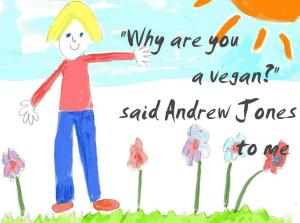
Why are you a vegan and other wacky verse for kids

Our new book Why are you a vegan? and other wacky verse for kids is finished and ready to be enjoyed 🙂

It is a compilation of our favourite rhyming stories, wacky verse and nursery rhymes, providing over 100 pages of colourfully illustrated bedtime (or anytime) stories and rhymes for little ones.

It includes

Why are you a vegan?

 “I’m not dinner!”

Edmund’s Lunch

bones and teef

and Where are you going Deidra?

Take a look inside:

Why are you a vegan and other wacky verse for kids

Why are you a vegan and other wacky verse for kids

[don’t worry, there’s a good comeback from Bertie on the next page 😉 ]

Why are you a vegan and other wacky verse for kids

Why are you a vegan and other wacky verse for kids

Why are you a vegan and other wacky verse for kids

It is available from Amazon in the UK, Europe and the USA.