Rat Trap

Another scientist speaks out against vivisection!

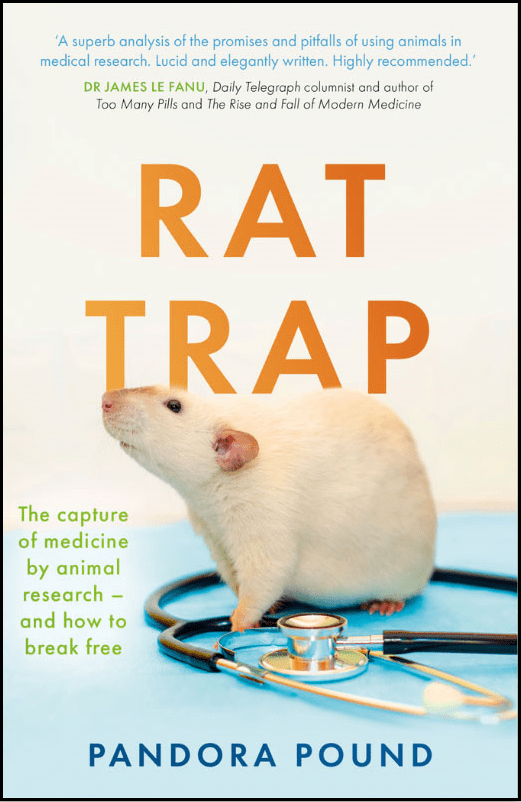
Rat Trap by Dr Pandora Pound

*

We have been supporters of Safer Medicines for many years so as soon as we saw this book by their Research Director, Dr Pandora Pound, we snapped it up.

It is a very well-written, easy to read book, full of all the information we need to know in our fight against vivisection. It is clearly and eloquently laid out and comes complete with many many citations.

I love the excitement and optimism the book has inspired:

“Rat Trap ends the debate about animal research once and for all. She shows that, far from being a necessary evil, it is one of the most important and urgent scientific issues of our time.

“Animal research harms patients and holds back medical progress. Superior technologies based on human biology could transform medicine if not for the iron grip of animal research.

“Rat Trap is dynamite! It blows the lid off decades of dogma.”

*

While we’re on the subject, the following video from 2019 is well worth half an hour of your time 🙂 (it is just a calm conversation, there are no disturbing images or descriptions).

*

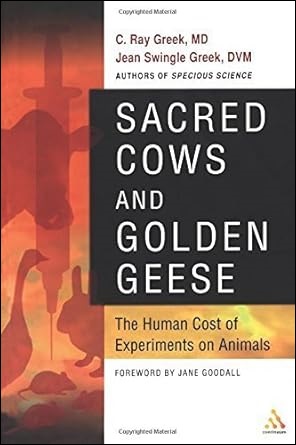
NB The pro-vivisection website Understanding Animal Research, criticised this video in an attempt to discredit Dr Greek (a board-certified anesthesiologist) by calling him a ‘conspiracy theorist’ and ‘science denialist’. So it’s very interesting that what Dr Pound tells us in Rat Trap about her personal experience as a scientist, and her research into this topic, corresponds with Dr Greek’s research and experience, and that of his wife and co-author, Jean Swingle Greek, who is a veterinary surgeon. Their findings were published over twenty years ago in their book Sacred Cows and Golden Geese: The Human Cost of Experiments on Animals.

Rat Trap by Pandora Pound
Highly recommended.
Sacred Cows and Golden Geese: the human cost of experiments on animals by Ray Greek MD and Jean Swingle Greek DVM
Another brilliant book on the subject which we have read several times and can highly recommend.

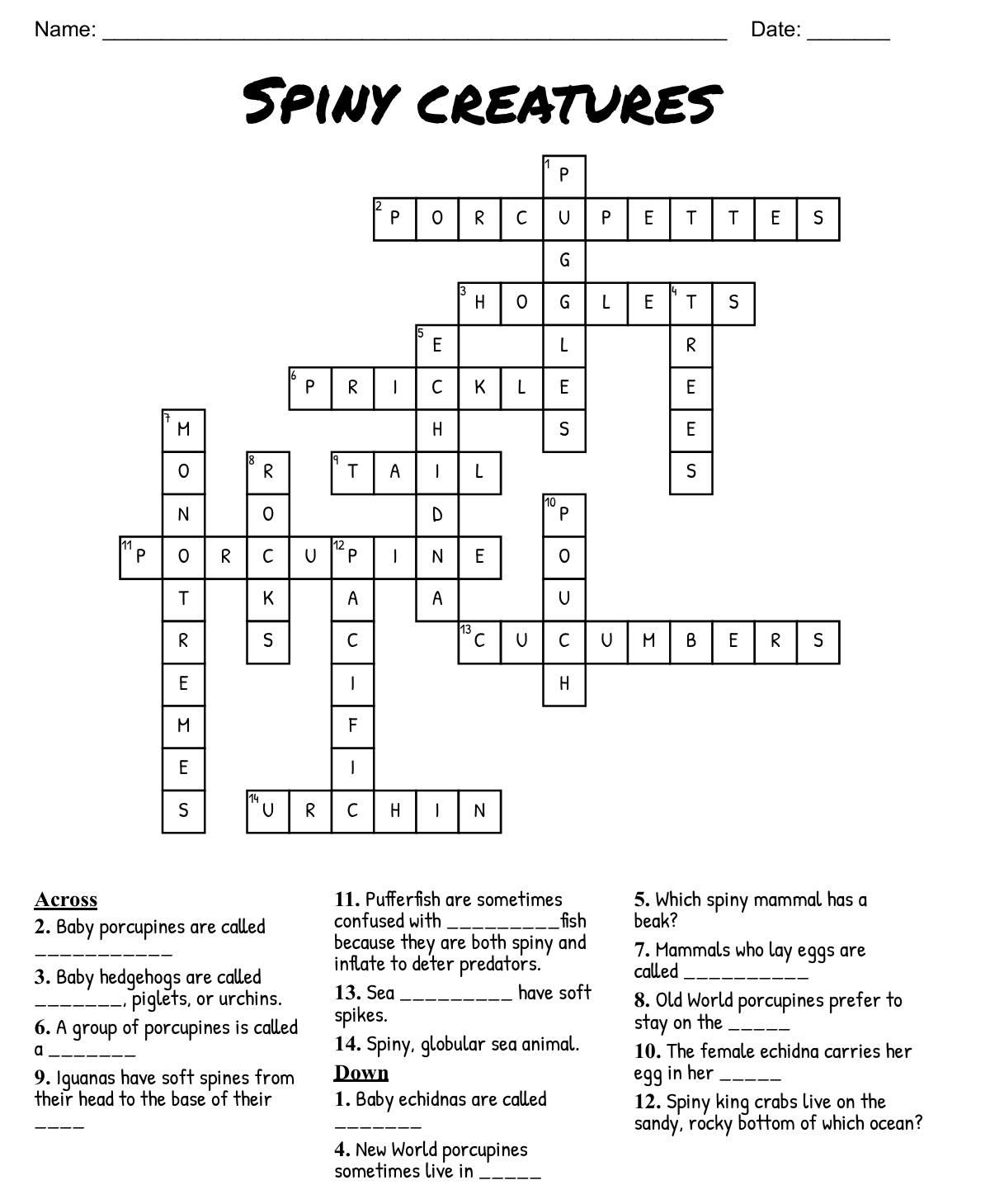
Spiny creatures puzzle answers

The Natural World crossword puzzle answers

Animals who live in the Rainforest wordsearch Answers

Animal-Free Research Crossword Answers

Teddy Bear with anti-vivisection science book
It just happens to be National Teddy Bear day so here’s one of ours 😀

*

And here are the answers to Friday’s crossword:

animal-free medical research  crossword answers

This is actually not an exhaustive list of scientifically valid (ie animal-free) methodologies, it’s just that if I’d included anymore it would have made the puzzle really small. I mean, the puzzle would have been bigger in that there would have been more questions and answers, but it would have been on a page the same size so the writing would have been too small. For me anyway 😉

But if you want to find out more about this stuff, click on the teddy bear. That highly-rated book, by the way, is already in our local library. Maybe it’s in yours too 🙂

Download the answers if you want to:

*

Violet's Vegan Comics logo

Violet’s Vegan Comics – creating vegan-friendly stories, poems and things-to-make-and-do since 2012

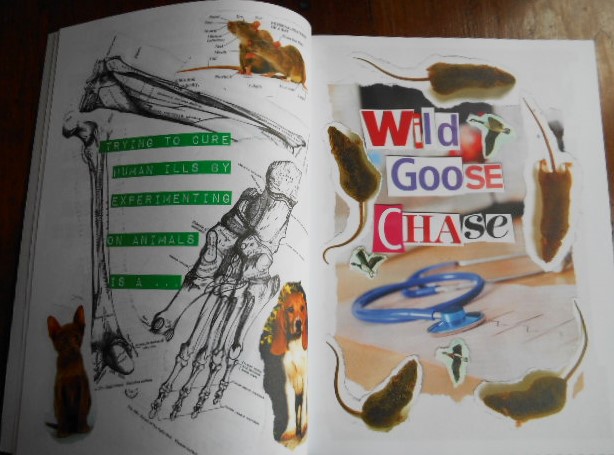
Experimenting on animals is a Wild Goose Chase

vegan book

New from Honestly Books is Wild Goose Chase by Lavender Laine which is perfect for the teens to adults section of our Vegan Children’s Books page.

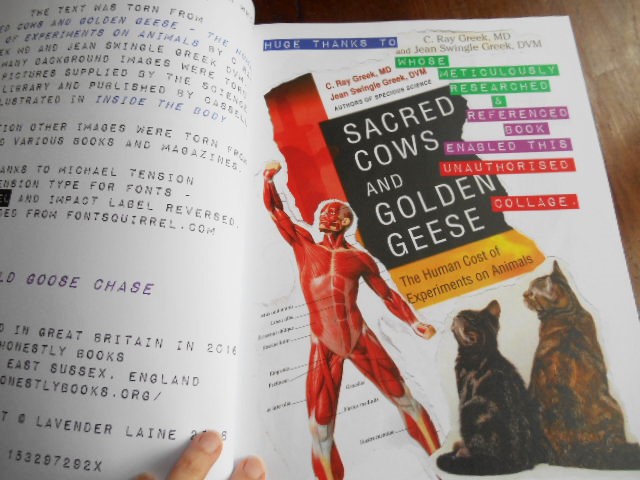
Lavender Laine, author of What’s good for the goose is not good for the panda, a rhyming story for little children, is a collage artist with a passionate opposition to vivisection.  Her latest title, the non-fiction Wild Goose Chase, is not only a feast for the eyes but also choc full of information that every anti-vivisectionist should know.  She has mined the brilliant Sacred Cows and Golden Geese by Ray and Jean Greek for all the text, which she has torn from its pages and pasted onto a backdrop of colourful images from many and various books and magazines.  The result is a stunning visual treat designed to make the historical scientific facts easier to remember.

On the first page is the classic quote from Dr Werner Hartinger: “There are, in fact, only two categories of doctors and scientist who are not opposed to vivisection: those who don’t know enough about it, and those who make money from it.”

vegan book

The acknowledgement pages follow:

vegan book

And then it begins with a statement that it will go on to prove: Trying to cure human ills by experimenting on animals is a wild goose chase.
vegan book

From thereon each page is full of information which was meticulously researched by the Greeks for Sacred Cows.  Laine has chosen excerpts from the Greeks’ book which she feels are the most important to commit to memory.  I’ve read Sacred Cows and Golden Geese several times from cover to cover and it teems with information explained in a way that is easy to make sense of for a non-scientific mind such as mine.  However, there is just so much information in there that, even after reading and re-reading, I find it hard to bring the facts to mind in conversation with others and therefore am unconvincing in my arguments.  That’s why Wild Goose Chase is so important.  Laine has included only a fraction of the text from Sacred Cows – giving us less to memorize – but those well chosen excerpts explain clearly and concisely why vivisection is scientifically flawed and why it continues in spite of that.

It’s a kind of CliffsNotes for Sacred Cows, but much more eye-catching.

vegan book

It begins with the history, showing that “True advances in medical knowledge has not come from animals.”  It reveals that Nobel Prizes were awarded to the wrong people – those who ‘validated’ things in animals decades after they had been discovered by other scientists in human observations.

vegan book

It explains how animal experiments have mislead scientists into thinking dangerous drugs were safe, and safe drugs were dangerous.

vegan book

It explains that animal tests continue in spite of this because they provide a legal ‘safe harbor’ for the government and drug companies who can claim due diligence when things go horribly wrong.

vegan book

It explains that, in the education system, original thinking is neither required nor welcomed; that editors and reviewers perpetuate the mass delusion; that money drives education and money drives research.

vegan book

It explains that what is needed is a ‘voluble public outcry’ to stop this scientific fraud which is killing so many humans and animals.  What is needed is for everyone to be aware of these facts so that they can no longer be deceived by the vivisectors’ PR machines.

vegan book

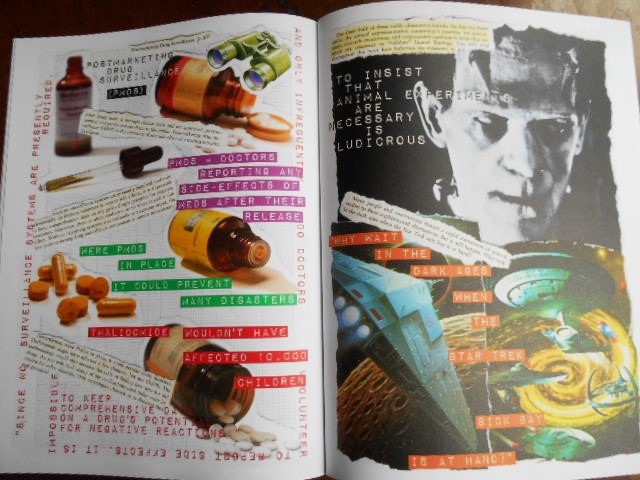
And then it goes on to explain what we should be doing instead of animal experiments: the scandalously underfunded human-based research methods which really could make a difference. Look – there’s Elvis! ↑
vegan book

Eg epidemiology, human autopsies, in vitro research, clinical observation, genetic research, computer modeling, diagnostic imaging, post-marketing drug surveillance.  It’s amazing what they can do now (and Sacred Cows was written sixteen years ago so think of the even more amazing advances that must have occurred since then).

“To insist that animal experiments are necessary is ludicrous.”

“Why wait in the dark ages when the Star Trek sick bay is at hand?”

vegan book

The book concludes with a call to action, inviting everyone to educate themselves and speak out against the mass delusion which is costing so many lives.

vegan book

There is nothing in this book but scientific and historical facts which are easily verified by referring to the indicated pages in Sacred Cows.  There are no disturbing images or descriptions of animal experiments – what would be the point?  If vivisection could be stopped on grounds of cruelty to animals it would have been banned a century ago.  Exposing the scientific fraud is the only way to end it.  Educating ourselves is where we start.  Buy this book and give it rave reviews!  Enable every teenager to understand that animal experiments are not necessary and never have been; that they are actually harmful to medical progress and will not save human lives.

H is for Herbivore

Cute-Rabbit-and-Girl-690x388

Herbivore    noun

Oxford Dictionary definition:  Plant-eating animal

Our definition:  Herbivores are animals which are anatomically designed to live on plants.  Herbivorous mammals have well-developed facial musculature, fleshy lips, a relatively small opening into the oral cavity and a thickened, muscular tongue. The lips aid in the movement of food into the mouth and, along with the facial (cheek) musculature and tongue, assist in the chewing of food.  The lower jaw of plant-eating mammals has a pronounced sideways motion when eating. This lateral movement is necessary for the grinding motion of chewing.

The dentition of herbivores is quite varied depending on the kind of vegetation a particular species is adapted to eat. Although these animals differ in the types and numbers of teeth they posses, the various kinds of teeth when present, share common structural features. The incisors are broad, flattened and spade-like. Canines may be small as in horses, prominent as in hippos, pigs and some primates (these are thought to be used for defense) or absent altogether. The molars, in general, are squared and flattened on top to provide a grinding surface. The molars cannot vertically slide past one another in a shearing/slicing motion (as carnivores’ teeth do), but they do horizontally slide across one another to crush and grind. The surface features of the molars vary depending on the type of plant material the animal eats. The teeth of herbivorous animals are closely grouped so that the incisors form an efficient cropping/biting mechanism, and the upper and lower molars form extended platforms for crushing and grinding.

These animals carefully and methodically chew their food, pushing the food back and forth into the grinding teeth with the tongue and cheek muscles. This thorough process is necessary to mechanically disrupt plant cell walls in order to release the digestible intracellular contents and ensure thorough mixing of this material with their saliva. This is important because the saliva of plant-eating mammals often contains carbohydrate-digesting enzymes which begin breaking down food molecules while the food is still in the mouth.

Because of the relative difficulty with which various kinds of plant foods are broken down (due to large amounts of indigestible fibres), herbivores have significantly longer and in some cases, far more elaborate guts than carnivores. Herbivorous animals that consume plants containing a high proportion of cellulose must “ferment” (digest by bacterial enzyme action) their food to obtain the nutrient value. They are classified as either “ruminants” (foregut fermenters) or hindgut fermenters. The ruminants are the plant-eating animals with the celebrated multiple-chambered stomachs. Herbivorous animals that eat a diet of relatively soft vegetation do not need a multiple-chambered stomach. They typically have a simple stomach, and a long small intestine. These animals ferment the difficult-to-digest fibrous portions of their diets in their hindguts (colons). Many of these herbivores increase the sophistication and efficiency of their GI tracts by including carbohydrate-digesting enzymes in their saliva.

In herbivorous animals, the large intestine tends to be a highly specialized organ involved in water and electrolyte absorption, vitamin production and absorption, and/or fermentation of fibrous plant materials. The colons of herbivores are usually wider than their small intestine and are relatively long.

“Thus, from comparing the gastrointestinal tract of humans to that of carnivores, herbivores and omnivores we must conclude that humankind’s GI tract is designed for a purely plant-food diet.”

Read the rest of the in-depth article by Dr Milton Mills, which includes comparisons with carnivore and omnivore anatomy and physiology, from which this definition was taken.

For the rest of the redefined words beginning with H, click on this pic (or go to the dictionary in the sidebar)

For the rest of the redefined words beginning with H, click on this pic (or go to the dictionary in the sidebar)

Doctor Slough invents a drug

Captain Janeway is awesome!