Z is for Zoo

Zoo    noun

Oxford Dictionary definition:  zoological garden: public garden or park with collection of animals for exhibition and study.

Our definition:  Place where wild animals are kept and/or bred in captivity.  Zoos are prisons.  Prisons in which innocent individuals are kept incarcerated for their whole lives, though they have committed no crime.

Elephants, for example, in the wild, are used to travelling many miles a day in herds of about ten related adults and their offspring. They are very social animals.

elephants captive and wild

In zoos, elephants are usually kept in pairs or even isolated.  Their enclosures are incredibly small, compared to what they are used to in the wild, and as a result they often show many signs of being stressed out or bored, like engaging in repetitive movements.  Stress behaviours can include repetitive movements, pacing back and forth, head bobbing, rocking, repeatedly retracing their steps, sitting motionless or biting the bars of their enclosure or themselves.

What makes life so difficult for zoo animals is that they hardly have any privacy and lack mental stimulation and physical exercise.  Even though you might think that zoo animals would get used to a life in captivity, they really don’t.  Even animals that are bred in zoos still retain their natural instincts after many generations of captive breeding.

Hippos captive and wild

Animals like polar bears or felines are used to hunting; this habit is replaced by the zoo with regular feedings.  Most animals kept in zoos would naturally roam for tens of miles a day.

Zoos claim to help with conservation. However, hardly any zoo registers their animals on an international species database and most zoo animals are not endangered at all.

Even though there are thousands of endangered species, zoos have only been able to return about 16 species to the wild with varying level of success. Most zoo animals released in the wild don’t survive. This is because zoos don’t provide the right environment for a successful captive breeding project. The animals would need to live in habitats resembling their natural ones, especially in terms of climate and fauna. The animals would also need to be raised with minimal human contact and in populations large enough to provide a natural social balance and a suitable gene pool.

Surplus animals are the unwanted animals for whom there is no more space, when zoos have bred yet another cute little baby to attract visitors. They can even be the cute babies themselves when they’ve stopped being cute at the end of the season. Zoos have a systematic “overproduction” of animals. These surplus animals are either killed – and sometimes fed to their fellow zoo habitants – or sold to other zoos or dealers.  Selling animals is a profitable way for zoos to dispose of them. Dealers will sell them to hunting ranches, pet shops, circuses, the exotic meat industry and research facilities. Surplus animals are also found for sale on the internet.

To sum up: DON’T GO TO THE ZOO!  If a school trip is being organised, tell your teacher why you don’t like zoos and ask them to take you somewhere better.  If they won’t listen, explain what zoos really are to your friends and then get together to petition the school.  If they still won’t listen, just ask your parents to let you stay home from school that day.  Maybe they could take you on a better trip instead, such as to a museum or art gallery.

That reminds me – see what Luke Walker, ‘animal stick up for-er’, did when he was forced to go on a trip to the zoo – now that’s a boy who acts on his conscience! (Though he is sadly unappreciated by those who know him 😉 )

W is for Winkle

W is for Whiting

W w

Whiting    noun

Oxford Dictionary definition:  small edible sea fish.

Juvenile-whiting

Juvenile-whiting

Our definition:  Whiting (Merlangius merlangus) fish are similar in appearance to their larger relatives,  cod, haddock, coley and pollack.  They have three dorsal fins separated by small gaps, the third fin extending almost to the tail fin.  The tail is not forked, having almost a square end.  The two anal fins are very close together, nearly touching one another and, together with the anterior fin, are elongated.  The pectoral fin is also long and projects beyond the base of the anal fin.  A whiting’s upper jaw projects slightly beyond the lower, and the lateral line is continuous along the length of the body.  In colour, individual fish vary quite a lot, and there is often a small dark blotch at upper base of the pectoral fin.  They can grow to up to 50 cm long.

Whiting matures at between three and four years of age, and spawning takes place at a depth of 20 to 150 m.  The time of the spawning varies from location to location: from January to spring in the Mediterranean; from January to September in the area between the British Isles and the Bay of Biscay; and throughout the year in the Black Sea.  A large female can produce up to one million eggs.  The eggs float in the open ocean and the larval whiting swim with other sea plankton until they have attained a length of around 10 cm.  The fish grow quickly, with females growing faster than males, and can live to about ten years of age.  The diet of the whiting consists of bottom-living organisms, such as crabs, shrimps, small fish, molluscs, worms, squid and cuttlefish.

The biggest threat to whiting is “over-harvesting” (euphemism) by the fishing fleets of many nations (of course).

Click here for the W page, and here for the rest of the vegan dictionary 😀

V is for Vegan

V v

Vegan    noun

Oxford Dictionary definition:  person who does not eat animals or animal products.

Our definition:  To be vegan means to try to do no harm to all animals, including humans, and the planet on which everyone depends.  This means a vegan will do their best to avoid all animal products in their food, clothes and possessions.  They will choose only fair trade and organic whenever possible, and will reduce, reuse and recycle to protect the world and its inhabitants from plastic pollution.  They will also avoid any activity or practice which exploits or abuses animals, such as visiting a zoo or buying animal-tested toiletries.

Just try to do no harm.  Easy 😀

Click here for the V page and here for the rest of the dictionary.

Have a lovely weekend 😀

U is for unethical, unprincipled, unkind ….

S is for Sturgeon

Sturgeon    noun

Oxford Dictionary definition:  large edible fish yielding caviar.

Our definition:  Sturgeons are native to subtropical, temperate and sub-Arctic rivers, lakes and coastlines of Eurasia and North America.  They are distinctive for their elongated bodies, lack of scales, and occasional great size: sturgeons ranging from 7–12 feet (2-3½ m) in length are common, and some species grow up to 18 feet (5.5 m). Most sturgeons are anadromous (migrating up rivers to spawn) bottom-feeders, spawning upstream and feeding in river deltas and estuaries.  While some are entirely freshwater, a very few venture into the open ocean beyond near coastal areas.

Sturgeon are primarily benthic  feeders (feeding on the river bed or ocean floor), with a diet of shells, crustaceans and small fish. They feed by extending their syphon-like mouths to suck food from the benthos.  Having no teeth, they are unable to seize prey, though larger individuals can swallow very large prey items, including whole salmon.  Sturgeons feed non-visually.  They are believed to use a combination of sensors, including olfactory sensors, tactile chemosensory cues on the 4 barbules, and passive electroreceptors (ampullae of Lorenzini).

Many sturgeon leap completely out the water, usually making a loud splash which can be heard half a mile away on the surface and probably further under water. It is not known why they do this, but suggested functions include group communication to maintain group cohesion, catching airborne prey, nuptial behaviour, or to help shed eggs during spawning. Other plausible explanations include escape from predators, shedding parasites, or to gulp or expel air. Another explanation is that it “simply feels good”.

Sturgeon can live 100 years and have been around since the dinosaurs.  Because of their long reproductive cycles, long migrations, and sensitivity to environmental conditions, many species are under severe threat from overfishing, poaching, water pollution, and damming of rivers.  There is also a noticeable decline in sturgeon populations as the demand for caviar increases (see Roe on the R page). According to the IUCN, over 85% of sturgeon species are classified as at risk of extinction, making them more critically endangered than any other group of species.

Click here for the S page, and here for the rest of the dictionary 🙂

I is for Inhuman

i

Working on the vegan dictionary continues to be a very educational experience.  Finding words which are defined in a way that normalises animal exploitation, (such as animals being described simply in terms of how they taste or how they are used by humans; or horrible, violent practices described in a brief, matter-of-fact way as if they are perfectly normal and inoffensive) and then redefining them so that they tell the whole story, good or bad.  I’m finding out a lot of very interesting facts about animals I previously knew nothing about, as well as a lot of very upsetting things which are hidden from the general population in order to preserve the status quo.

Today I was leafing through the i section of the dictionary and, unusually, finding nothing that needed redefining …. until I reached inhuman, described thus in the Oxford Dictionary:

adjective:    brutal; unfeeling; barbarous

And the synonyms for inhuman, given in the thesaurus section, are:

animal, barbaric, barbarous, bestial, bloodthirsty, brutal, brutish, diabolical, fiendish, inhumane, merciless, pitiless, ruthless, savage, unfeeling, unnatural, vicious.

Now I’m confused.

Isn’t it humans who enslave and brutalise animals for pleasure and profit?  Isn’t it humans who are so unfeeling that they steal a baby from his mother and kill him so that they can have his mother’s milk for themselves?  Isn’t it humans who show no mercy to the billions of terrified, innocent individuals who are savagely and routinely killed en masse?

With the exception of the word ‘animal’ it seems to me that those synonyms should be in the dictionary next to the word human, not inhuman.

The thing is that humans, most of them, do think of themselves as good and kind, decent and compassionate, and the dictionary reflects that.  But, however good and charitable a human might be towards other humans, if their compassion doesn’t extend to other species then is not a part of them still barbaric, merciless, unfeeling, pitiless, ruthless and savage, albeit perhaps unwittingly so?  Even if they do not commit the fiendish acts themselves; even if they are horrified at the idea of hurting a living being; if they know about it and still choose to pay for it, are they not directly and deliberately responsible for it?  And isn’t that diabolical?

The good news is that it is entirely possible to make the Oxford Dictionary definition correct.  If all humans went vegan (as nature intended) then the word human really would be synonymous with compassionate, and inhuman would mean what the Oxford Dictionary says it means 🙂

G is for Greyhound

Jasmine

Jasmine the rescued greyhound with one of her many fostered youngsters. Click on the pic

Greyhound    noun

Oxford Dictionary definition:  Slender swift dog used in racing.

Our definition:  Greyhounds are quiet, gentle, and loyal.  They are very loving and enjoy the company of their humans and other dogs.   Jasmine, a beautiful, rescued greyhound puppy who grew up to be a permanent resident at Nuneaton & Warwickshire Wildlife Sanctuary and an extremely well loved member of their team, is a perfect example of how loving these animals are.   Tragically so many gentle individuals like her are exploited and abused by the greyhound racing industry.

And the G g page is done! Click on the pic or go to the dictionary in the sidebar

And the G g page is done! Click on the pic or go to the dictionary in the sidebar

C is for Crab

hermit crab

Crab    noun

Oxford Dictionary definition:  1.  Shellfish with 10 legs  2.  This as food

Our definition:  1.  Crabs are sentient beings who live in all the world’s oceans, in fresh water, and on land, are generally covered with a thick exoskeleton and have a single pair of claws.  They attract a mate through chemical (pheromones), visual, acoustic or vibratory means. Pheromones are used by most fully aquatic crabs, while terrestrial and semi-terrestrial crabs often use visual signals, such as fiddler crab males waving their large claw to attract females. Crabs are mostly active animals with complex behaviour patterns.  They can communicate by drumming or waving their pincers.  Males will fight to win females or to defend territory.  Fiddler Crabs dig burrows in sand or mud, which they use for resting, hiding, mating and to defend against intruders. Crabs are omnivores, feeding primarily on algae, and taking any other food, including molluscs, worms, other crustaceans, fungi, bacteria and detritus, depending on their availability and the crab species.

2.  Crabs are boiled alive by humans who want to eat them.

*************

C

The Cc page is done now (click on the pic or go to the dictionary in the sidebar).

I’ll be starting on Dd today 😀

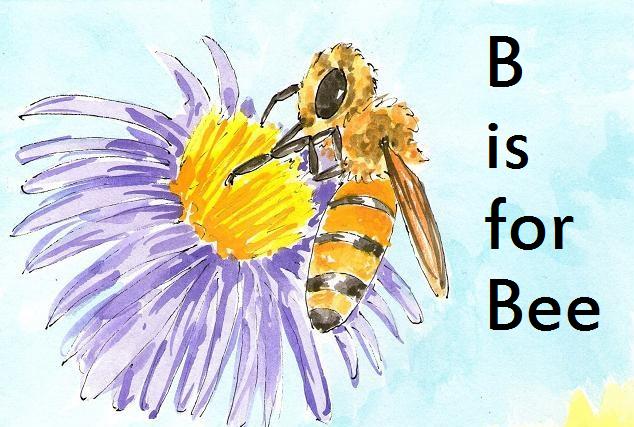
B is for Bee

b is for bee

Compiling the vegan dictionary is taking a long time and I won’t be able to complete a letter in one day as I naïvely first thought.  I have only just finished Bb so won’t be able to share any C words until at least tomorrow 🙂  In the meantime, Miranda thought it might be a good idea to post an excerpt of Bb – so here it is:

Bee    noun

Oxford Dictionary definition:  Four-winged stinging insect, collecting nectar and pollen and producing honey and wax.

Our definition:  There are lots of different types of bee in the UK, around 250 species – 24 species of bumble bee, 225 species of solitary bee and just one species of honey bee.  Honey bees will live through the winter, eating and working all winter long, which of course requires a large store of food – hence the honey they’ve worked hard for all summer.  With Bumble bees however, the new queens, after mating, find somewhere to hibernate and the rest of the colony dies off.  While hibernating she does not need to eat so there are no honey stores.  In the spring when she has to work hard, she makes a small pot of honey for herself.    Solitary bees typically produce neither honey nor wax.  They are important pollinators as the females, who are all fertile, build their own nests and take care of their own young so pollen is gathered for provisioning the nest with food for their brood.  Bees gathering nectar (eg honey bees) may accomplish pollination, but bees that are deliberately gathering pollen (eg solitary orchard mason bees) are more efficient pollinators.  There are also 500 species of stingless bee