Z is for Zoo

Zoo    noun

Oxford Dictionary definition:  zoological garden: public garden or park with collection of animals for exhibition and study.

Our definition:  Place where wild animals are kept and/or bred in captivity.  Zoos are prisons.  Prisons in which innocent individuals are kept incarcerated for their whole lives, though they have committed no crime.

Elephants, for example, in the wild, are used to travelling many miles a day in herds of about ten related adults and their offspring. They are very social animals.

elephants captive and wild

In zoos, elephants are usually kept in pairs or even isolated.  Their enclosures are incredibly small, compared to what they are used to in the wild, and as a result they often show many signs of being stressed out or bored, like engaging in repetitive movements.  Stress behaviours can include repetitive movements, pacing back and forth, head bobbing, rocking, repeatedly retracing their steps, sitting motionless or biting the bars of their enclosure or themselves.

What makes life so difficult for zoo animals is that they hardly have any privacy and lack mental stimulation and physical exercise.  Even though you might think that zoo animals would get used to a life in captivity, they really don’t.  Even animals that are bred in zoos still retain their natural instincts after many generations of captive breeding.

Hippos captive and wild

Animals like polar bears or felines are used to hunting; this habit is replaced by the zoo with regular feedings.  Most animals kept in zoos would naturally roam for tens of miles a day.

Zoos claim to help with conservation. However, hardly any zoo registers their animals on an international species database and most zoo animals are not endangered at all.

Even though there are thousands of endangered species, zoos have only been able to return about 16 species to the wild with varying level of success. Most zoo animals released in the wild don’t survive. This is because zoos don’t provide the right environment for a successful captive breeding project. The animals would need to live in habitats resembling their natural ones, especially in terms of climate and fauna. The animals would also need to be raised with minimal human contact and in populations large enough to provide a natural social balance and a suitable gene pool.

Surplus animals are the unwanted animals for whom there is no more space, when zoos have bred yet another cute little baby to attract visitors. They can even be the cute babies themselves when they’ve stopped being cute at the end of the season. Zoos have a systematic “overproduction” of animals. These surplus animals are either killed – and sometimes fed to their fellow zoo habitants – or sold to other zoos or dealers.  Selling animals is a profitable way for zoos to dispose of them. Dealers will sell them to hunting ranches, pet shops, circuses, the exotic meat industry and research facilities. Surplus animals are also found for sale on the internet.

To sum up: DON’T GO TO THE ZOO!  If a school trip is being organised, tell your teacher why you don’t like zoos and ask them to take you somewhere better.  If they won’t listen, explain what zoos really are to your friends and then get together to petition the school.  If they still won’t listen, just ask your parents to let you stay home from school that day.  Maybe they could take you on a better trip instead, such as to a museum or art gallery.

That reminds me – see what Luke Walker, ‘animal stick up for-er’, did when he was forced to go on a trip to the zoo – now that’s a boy who acts on his conscience! (Though he is sadly unappreciated by those who know him 😉 )

W is for Winkle

W is for Whiting

W w

Whiting    noun

Oxford Dictionary definition:  small edible sea fish.

Juvenile-whiting

Juvenile-whiting

Our definition:  Whiting (Merlangius merlangus) fish are similar in appearance to their larger relatives,  cod, haddock, coley and pollack.  They have three dorsal fins separated by small gaps, the third fin extending almost to the tail fin.  The tail is not forked, having almost a square end.  The two anal fins are very close together, nearly touching one another and, together with the anterior fin, are elongated.  The pectoral fin is also long and projects beyond the base of the anal fin.  A whiting’s upper jaw projects slightly beyond the lower, and the lateral line is continuous along the length of the body.  In colour, individual fish vary quite a lot, and there is often a small dark blotch at upper base of the pectoral fin.  They can grow to up to 50 cm long.

Whiting matures at between three and four years of age, and spawning takes place at a depth of 20 to 150 m.  The time of the spawning varies from location to location: from January to spring in the Mediterranean; from January to September in the area between the British Isles and the Bay of Biscay; and throughout the year in the Black Sea.  A large female can produce up to one million eggs.  The eggs float in the open ocean and the larval whiting swim with other sea plankton until they have attained a length of around 10 cm.  The fish grow quickly, with females growing faster than males, and can live to about ten years of age.  The diet of the whiting consists of bottom-living organisms, such as crabs, shrimps, small fish, molluscs, worms, squid and cuttlefish.

The biggest threat to whiting is “over-harvesting” (euphemism) by the fishing fleets of many nations (of course).

Click here for the W page, and here for the rest of the vegan dictionary 😀

V is for Vegan

V v

Vegan    noun

Oxford Dictionary definition:  person who does not eat animals or animal products.

Our definition:  To be vegan means to try to do no harm to all animals, including humans, and the planet on which everyone depends.  This means a vegan will do their best to avoid all animal products in their food, clothes and possessions.  They will choose only fair trade and organic whenever possible, and will reduce, reuse and recycle to protect the world and its inhabitants from plastic pollution.  They will also avoid any activity or practice which exploits or abuses animals, such as visiting a zoo or buying animal-tested toiletries.

Just try to do no harm.  Easy 😀

Click here for the V page and here for the rest of the dictionary.

Have a lovely weekend 😀

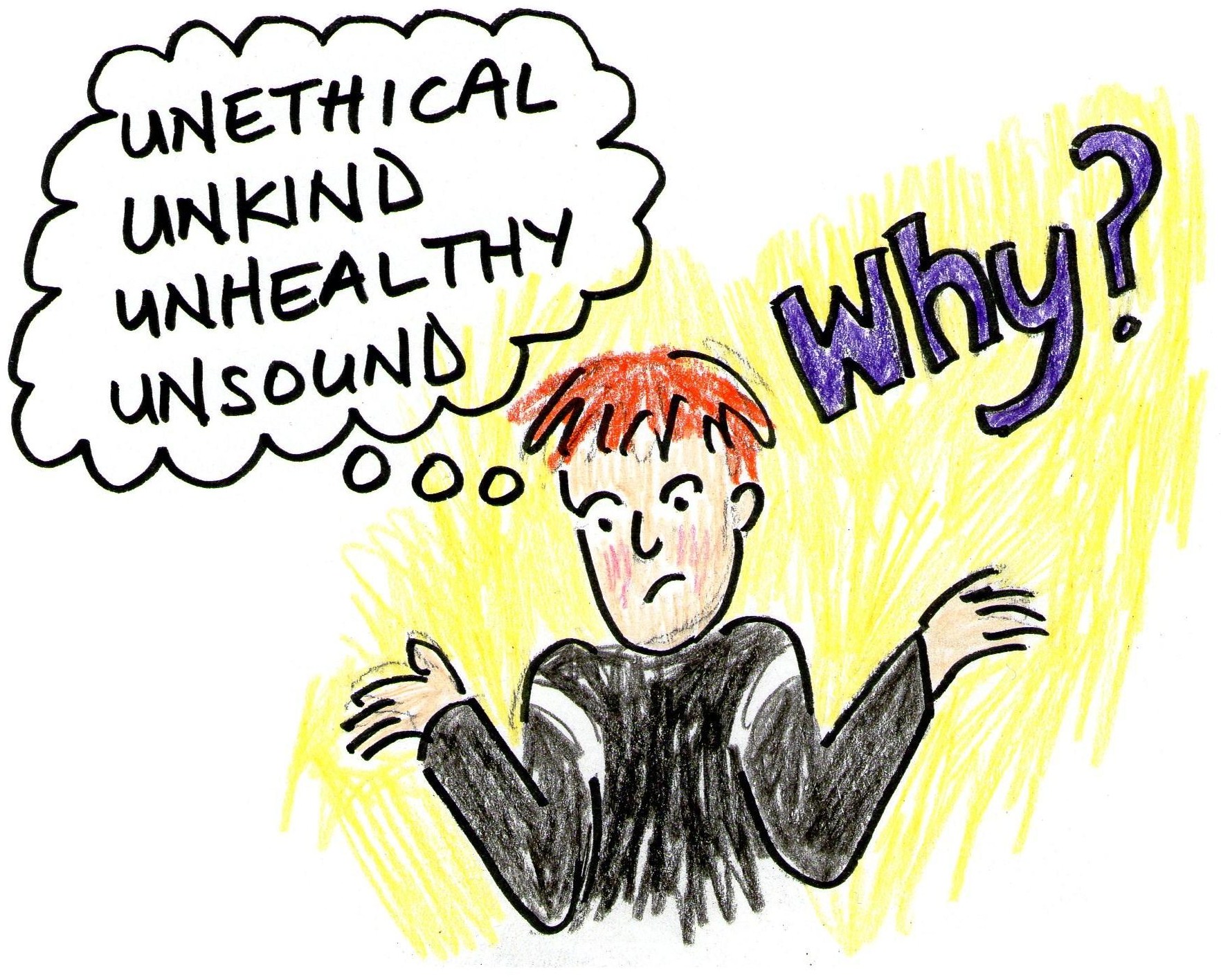
U is for unethical, unprincipled, unkind ….

O is for omelette

Oo

Omelette    noun

Oxford Dictionary definition:  beaten eggs fried and often folded over filling.

Our definition:  Omelettes are made from eggs laid by birds (usually chickens) kept in unnatural, confined conditions, more often than not in over-crowded barns with no access to the outside and no natural light or fresh air.  Their miserable lives are short, ending when they begin to lay less eggs at about 12 to 18 months of age (naturally, healthy chickens could live into their teens if not taken by a predator, though those rescued from chicken farms don’t usually live longer than 4 years due to their harrowing start in life).  Contrary to popular opinion, buying free range is not the cruelty free option since these birds’ lives will also end in brutal slaughter by the tender age of 18 months.  NB farms can label their eggs free range if there is access to an outdoor area from the chickens’ barn even though most of the birds in the overcrowded barn are never able to reach the door.  Male chicks are horribly killed en masse shortly after hatching.

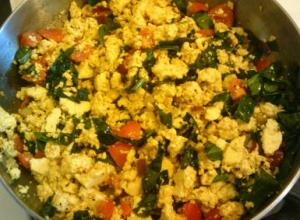
Buying tofu, on the other hand, is the cruelty free option and if you love eggs, you’ll really love tofu 😀

Spinach Tofu Scramble. Photo by Evelyn Oliver

Spinach Tofu Scramble. Photo by Evelyn Oliver

For the rest of the dictionary, click here

N is for Nutria

Nutria    noun

Oxford Dictionary definition:  coypu fur

Our definition:   Nutria (also called coypu) are large, rodents who are more agile in the water than on land. They live in burrows, or nests, never far from the water.  Nutria may inhabit a riverbank or lakeshore, or dwell in the midst of wetlands. They are strong swimmers and can remain submerged for as long as five minutes.  Their average lifespan in the wild is eight to ten years.  They are varied eaters, most fond of aquatic plants and roots, and are very very cute.  Quite beaver-like 😀

Nutria can be rather social animals and sometimes live in large colonies, reproducing prolifically. Females have two or three litters every year, each consisting of five to seven young. These animals mature quickly and remain with their mothers for only a month or two.

Tragically, many misguided humans have cruelly exploited nutria on fur farms (“Originally native to subtropical and temperate South America, it has since been introduced to North America, Europe, Asia, and Africa, primarily by fur ranchers“) and, when these ventures failed and the captive animals escaped or were released into parts of the world where they didn’t belong, they bred fast and caused a lot of damage to wetlands.  This has resulted in many attempts to cull them worldwide including, in the US, incentives being paid to people to hunt and trap them.  They get $5 per nutria tail handed in to a Coastal Environments Inc. official.

Click here for the N page and here for the rest of the vegan dictionary

I is for Inhuman

i

Working on the vegan dictionary continues to be a very educational experience.  Finding words which are defined in a way that normalises animal exploitation, (such as animals being described simply in terms of how they taste or how they are used by humans; or horrible, violent practices described in a brief, matter-of-fact way as if they are perfectly normal and inoffensive) and then redefining them so that they tell the whole story, good or bad.  I’m finding out a lot of very interesting facts about animals I previously knew nothing about, as well as a lot of very upsetting things which are hidden from the general population in order to preserve the status quo.

Today I was leafing through the i section of the dictionary and, unusually, finding nothing that needed redefining …. until I reached inhuman, described thus in the Oxford Dictionary:

adjective:    brutal; unfeeling; barbarous

And the synonyms for inhuman, given in the thesaurus section, are:

animal, barbaric, barbarous, bestial, bloodthirsty, brutal, brutish, diabolical, fiendish, inhumane, merciless, pitiless, ruthless, savage, unfeeling, unnatural, vicious.

Now I’m confused.

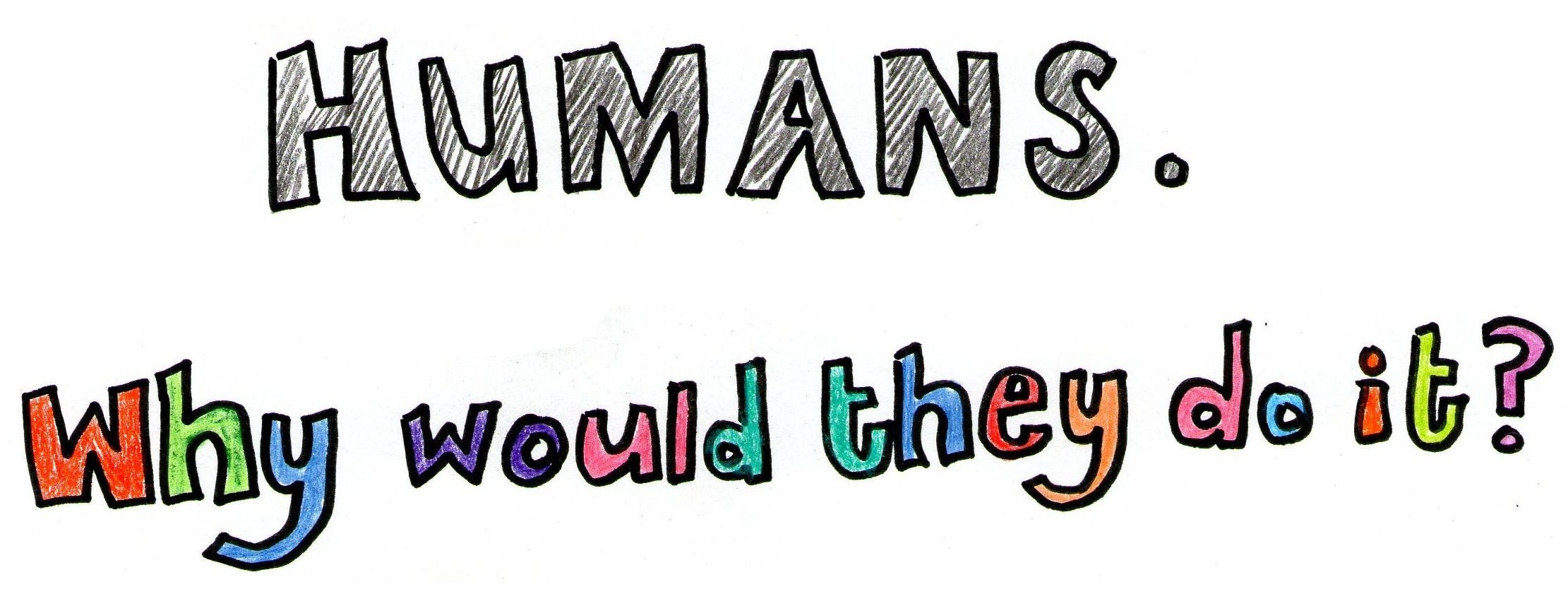
Isn’t it humans who enslave and brutalise animals for pleasure and profit?  Isn’t it humans who are so unfeeling that they steal a baby from his mother and kill him so that they can have his mother’s milk for themselves?  Isn’t it humans who show no mercy to the billions of terrified, innocent individuals who are savagely and routinely killed en masse?

With the exception of the word ‘animal’ it seems to me that those synonyms should be in the dictionary next to the word human, not inhuman.

The thing is that humans, most of them, do think of themselves as good and kind, decent and compassionate, and the dictionary reflects that.  But, however good and charitable a human might be towards other humans, if their compassion doesn’t extend to other species then is not a part of them still barbaric, merciless, unfeeling, pitiless, ruthless and savage, albeit perhaps unwittingly so?  Even if they do not commit the fiendish acts themselves; even if they are horrified at the idea of hurting a living being; if they know about it and still choose to pay for it, are they not directly and deliberately responsible for it?  And isn’t that diabolical?

The good news is that it is entirely possible to make the Oxford Dictionary definition correct.  If all humans went vegan (as nature intended) then the word human really would be synonymous with compassionate, and inhuman would mean what the Oxford Dictionary says it means 🙂

Bb-Day is here!

Rethinking the language with a vegan dictionary

vegan dictionary

So often we realise, and sometimes we don’t realise, that the words we use normalise animal exploitation and degradation.  A man might be angrily referred to as a ‘pig’ because he behaves in an obnoxious or sexist manner; a person might be called an ‘animal’ if they are aggressive or bad mannered; some animals are described by the way they taste instead of by characteristics which actually tell us something about them as individuals; people are desensitised to the harsh realities which face captive animals every day because words, like ‘abattoir’ for example, are defined simply as slaughterhouse which doesn’t begin to convey the horror and becomes an accepted and unquestioned fact that doesn’t make people recoil or revolt.

The other side of this coin is that some words are only described in relation to animal farming when in fact there is so much more to them (see alfalfa).

So we thought it would be a good idea to make a vegan dictionary, with words defined from a vegan point of view, and we’ll keep it high up in the sidebar for easy reference.  It will take a long time to complete – so far I have just done A! – but it is a very interesting endeavour and I am enjoying it.

DSCN3054

I began by referring to my big old Oxford dictionary.  I went through the A section, page by page, and every time I came across a word which normalised animal exploitation or degradation, or which was defined in a way which did, I copied it down and defined it honestly and fully to the best of my ability.  I also include the Oxford definition in my dictionary for comparison.

You can find the dictionary by clicking on the picture at the top of this post, or on the picture of the dictionary in the sidebar and that will take you to links to the lettered pages – so far, as I said, just A, but I’ll get started on B today!

I believe that most people, whether they be veg*n or not, have compassion for animals and the reason that many of those who feel love for other species still eat some of them is because they have been conditioned from birth not to question it.  It is deeply embedded in the language they speak.

When I was 13 I told my dad that I wanted to be vegetarian and he asked me why.  I told him that it was because I didn’t want animals to be killed.  He explained to me earnestly that it was all done humanely; that they don’t suffer.  He didn’t know that.  He didn’t know anything about animal farming or slaughter, but he believed it to be true.  He had been told that there were regulations in place to make sure the animals didn’t suffer and he believed it.  And he told me that it was true.  And that’s what most people think:  it is normal, it is natural and it is humane.

But it isn’t any of those things so we need a new normal, and it starts with the language.