
Click here for episode 3
*

*

*

*

*
*

*
*

*
*

*
Go to episode 5
***
This story is included in the book Vegan Rascals Collection, available from all good bookshops.

Look inside:
*
SOURCES:
NB When writing to “green” energy companies, asking them to stop erecting wind turbines, I have repeatedly been told “I know it’s a shame they kill birds, but it’s better than fossil fuels.” ! They say this as if those are the only choices – turbines or coal – which is just not true! I am not asking them to go back to fossil fuels. I am asking them to invest in wildlife-friendly renewable energy generators, but they will not even discuss it. Strange don’t ya think?
The following text (in green) was taken from an article by Chris Clark in January 2013, www.pbssocal.org/redefine/uk-ecologist-wind-farms-driving-birds-bats-to-extinction-0 :
In an essay that’s getting some serious traction in environmentalist circles, Clive Hambler — a lecturer at Oxford, and author of the Cambridge University Press text “Conservation” — slams the wind industry in no uncertain terms, saying that the sector’s support from environmentalists comes as a result of environmentalists being essentially ignorant of science:
Hambler cites some distressing statistics from sources around the world. Between 6-18 million birds and bats are killed by Spanish wind farms each year Hambler says, including 400 griffon vultures per year just at Navarro. German wind turbines kill at least 200,000 bats per year, depressing populations up to 2,000 miles away. Wind turbines in the U.S. have been estimated to kill 70 bats per installed megawatt per year, on average, says Hambler. That would work out to about 320,000 bats per year in California.
Hambler’s assessment of the reasons for wind power’s popularity among environmentalists is rather unsparing:
“Why is the public not more aware of this carnage? First, because the wind industry (with the shameful complicity of some ornithological organisations) has gone to great trouble to cover it up — to the extent of burying the corpses of victims. Second, because the ongoing obsession with climate change means that many environmentalists are turning a blind eye to the ecological costs of renewable energy. What they clearly don’t appreciate is that most of the species they claim are threatened by ‘climate change’ have already survived 10 to 20 ice ages, and sea-level rises far more dramatic than any we have experienced in recent millennia or expect in the next few centuries. Climate change won’t drive those species to extinction; well-meaning environmentalists might.”
Inventors and designers have created renewable energy generators that don’t kill birds or other animals – some years ago actually though they’re still not in use – but if governments had enforced a strict line that couldn’t be crossed in the first place, eg The invention MUST NOT cause any harm to wildlife, then the harmless ones would have been invented sooner, with no loss of life.
Anyway, here are the sources I found while researching Venus #4:
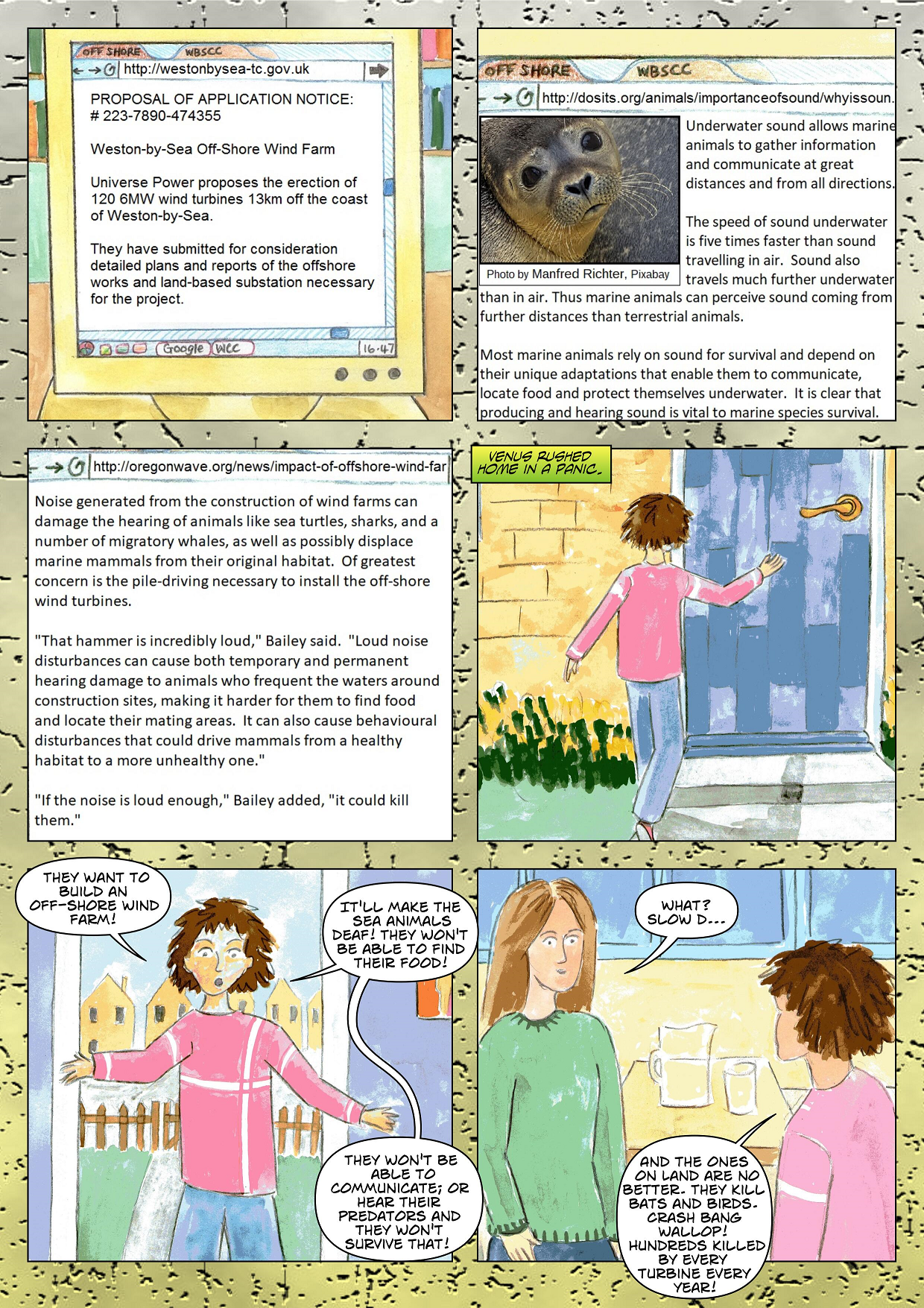
http://www.umces.edu/cbl/release/2014/oct/13/assess-impacts-offshore-wind-farms-marine-specie
The St Andrews researchers attached GPS data loggers to 24 harbour seals while offshore wind turbines were being installed in the Wash in 2012. The data loggers collected information on the seals’ locations and their diving behaviour.
They then combined this data with information from the wind farm developers on when pile driving was taking place to produce models which predicted the noise each seal was exposed to. They compared this with noise levels that other studies show caused auditory damage.
The model revealed that half of the tagged seals were exposed to noise levels that exceeded hearing damage thresholds.
Offshore wind turbines are installed using pile drivers – essentially large hammers that drive the foundation posts into the sea bed – which produce short pulsed sounds every few seconds.
The lead author, Dr Gordon Hastie of the university’s Sea Mammal Research Unit said, “These are some of the most powerful man-made sounds produced underwater, noise capable of travelling large distances underwater.”
https://www.heraldscotland.com/news/13214533.fears-raised-damage-seals-hearing-pile-driving-offshore-wind-turbines/He said very little was known about the impact of the pulsed sounds on seals. However, a wealth of data existed on the effect on humans and other terrestrial species, data which showed that powerful pulsed sounds could damage mammals’ hearing.
“Like most marine mammals, harbour seals have very sensitive underwater hearing at a much broader range of frequencies than humans,” said Dr Hastie. “Seals probably use underwater hearing during the mating season and to detect and avoid predators. They may also rely on their hearing for navigation and finding prey.”
*
Why is sound important to marine animals?
In addition to vision, marine animals use other mechanisms, such as sound, to gather information and communicate. Photo of harbor seal courtesy of Sean A. Hayes, Salmon Ecology Group, NMFS.
Hearing is the universal alerting sense in all vertebrates. Sound is so important because animals are able to hear events all around them, no matter where their attention is focused. Many species of blind amphibians, reptiles, fishes and mammals are known, but no naturally profoundly deaf vertebrate species have been discovered. Although hearing is important to all animals, the special qualities of the undersea world emphasize the use of sound.
Underwater sound allows marine animals to gather information and communicate at great distances and from all directions. The speed of sound determines the delay between when a sound is made and when it is heard. The speed of underwater sound is five times faster than sounds traveling in air. Sound travels much further underwater than in air. Thus marine animals can perceive sound coming from much further distances than terrestrial animals. Because the sound travels faster, they also receive the sounds after much shorter delays (for the same distance). It is no surprise that marine mammals have evolved many different uses for sounds.
Marine animals rely on sound to acoustically sense their surroundings, communicate, locate food, and protect themselves underwater. Marine mammals, such as whales, use sound to identify objects such as food, obstacles, and other whales. By emitting clicks, or short pulses of sound, marine mammals can listen for echoes and detect prey items, or navigate around objects. This animal sense functions just like the sonar systems on navy ships. It is clear that producing and hearing sound is vital to marine mammal survival.
Sound is also important to fishes. They produce various sounds, including grunts, croaks, clicks, and snaps, that are used to attract mates as well as ward off predators. For the oyster toadfish, sound production is very important in courtship rituals. Sound is produced by the male toadfish to attract the female for mating and is especially important in the murky waters that toadfish inhabit where sight is limited.
Marine invertebrates also rely on sound for mating and protection. Little research has been done on marine invertebrates that produce sounds, but for those that do, like shrimp and lobsters, sound is very important for survival against predators.
As you can see, sound is very important to its underwater inhabitants. Most marine animals rely on sound for survival and depend on their unique adaptations that enable them to communicate, locate food, and protect themselves underwater.
https://dosits.org/animals/importance-of-sound/why-is-sound-important/
*
*
https://www.eagles.org/take-action/wind-turbine-fatalities/ :
“A 2013 study published in The Wildlife Society Bulletin found that wind turbines killed an estimated 573,000 birds annually in the United States. … An even more alarming fact is that the data on the number of deaths is gathered by paid consultants to the wind industry. That’s the fox guarding the chicken house. At the infamous Altamont Wind Resource Area alone, more than 2,000 Golden Eagles have been killed by the wind turbines there.
“The size of each traditionally designed industrial wind turbine is staggering. An average tower is 212 feet (but can go well over that), with arms 116 feet long – that’s an enormous area that is covered as the blades rotate.
“During construction of a wind turbine, roads often have to be widened or built from scratch; mountain tops are sometimes blasted away to create a level area of at least 3 acres, so that the platform can be stable enough to support the enormous weight of each turbine assembly.
“Alternative energy is not ‘green’ if it is killing hundreds or thousands or millions of birds annually,” said Dr. Hutchins. “Our wildlife should not be collateral damage in our effort to combat climate change, nor does it have to be.”
Original Open Access Research by Peter Schippers, Ralph Buij, Alex Schotman, Jana Verboom, Henk van der Jeugd, Eelke Jongejans – ‘Mortality limits used in wind energy impact assessment underestimate impacts of wind farms on bird populations’ : https://onlinelibrary.wiley.com/doi/full/10.1002/ece3.6360
A Refreshing Alternative: http://gdonna.com/living-like-the-past/before-electricity/
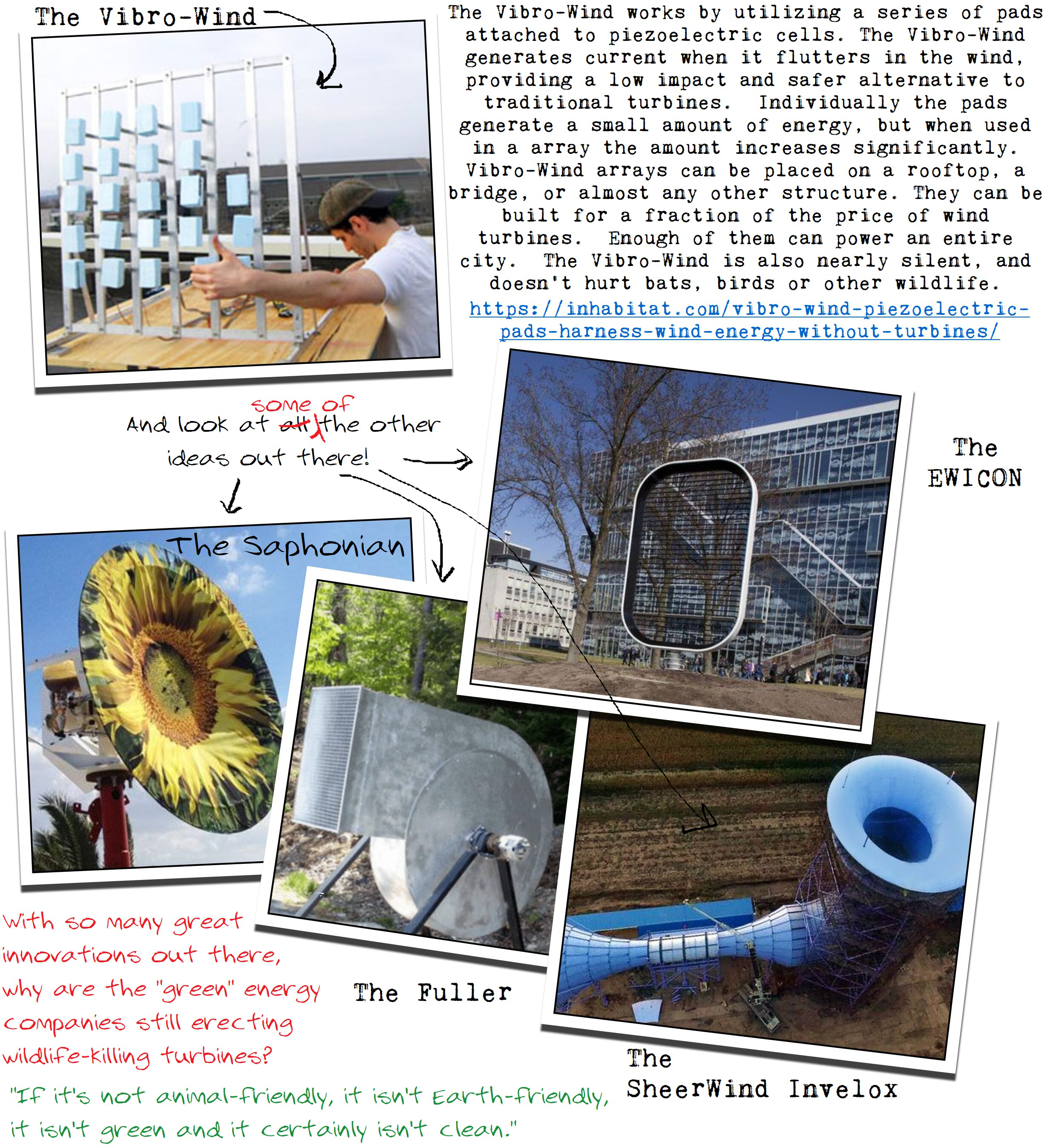
And if there must be electricity, maybe the following windy ideas might be more animal friendly? (let’s hope this time they’ll make sure before installing them)
Bladeless Wind Turbines: Tesla Technology That’s Revolutionizing Energy Production
“Current wind turbines with rotating blades are visually obstructive, mechanically inefficient, cause noise pollution, and have been reported to have detrimental health effects on residents living near them. Furthermore, bladed wind turbines have also proven to be a major hazard for wildlife such as birds and bats, killing nearly 600,000 birds a year [in the US alone].
“As a result of their many disadvantages, a number of cities and municipalities in countries across the world have banned the installation and use of bladed wind turbines.
“A number of modern designers, utilizing technology first patented by Nikola Tesla over 100 years ago, have developed innovative bladeless wind turbines that resolve all of the issues with bladed wind turbines.
“Bladeless Wind Turbine #1: The Saphonian
With a design inspired by a ship’s sails, Saphon Energy has created the Saphonian – a bladeless wind turbine at double the efficiency, and half the cost, of a regular wind turbine. According to Saphon Energy, the Saphonian is more efficient than bladed turbines and its Performance Coefficient (Cp) is way beyond Betz Limit (59.3%). The Saphonian efficiency level stands at the outstanding level of around 80% and therefore, its generated power increases exponentially with the wind speed.“Bladeless Wind Turbine #2: The EWICON
A group of architects from one of the leading technical universities in Europe called Delft University of Technology have developed a revolutionary wind energy generator called the EWICON (Electrostatic Wind Energy Converter). It is highly efficient, has no moving parts, undergoes little wear and tear and requires almost no maintenance.“Perhaps the most important design feature of the UWICON is that it makes no noise and casts no moving shadows, two of the principal complaints that regularly deter wind turbine installation.
“Bladeless Wind Turbine #3: The Fuller
“In 2009, the New Hampshire company Solar Aero unveiled a prototype bladeless wind turbine with the virtue of only one rotating part, its turbine driveshaft. The Fuller bladeless wind turbine is based largely on the work of Nikola Tesla, and in 2010 the company received a patent for its device.“According to the patent, “The present invention provides a further improvement over the basic concept of a Tesla turbine. The turbine of the present invention is particularly useful as a wind turbine or the like, and provides maximum efficiency in converting wind energy to mechanical power. It can also be used in geothermal applications, in which a refrigerant fluid, flowing in a closed loop, is used to drive the turbine.”
“Like other bladeless turbines, the entire assembly is contained inside a housing, which effectively eliminates any threat to wildlife.
“Bladeless Wind Turbine #4: Catching Wind Power
“89-year-old World War II veteran Raymond Green has invented a bladeless wind turbine called Catching Wind Power which is bird and bat-friendly and very quiet in operation.
“ ‘Our design does not have any external moving parts to hit the birds,’ writes Green on his website. ‘Our unit is easy to see so the birds can avoid it, and all moving parts are internal. The blades are mounted behind the windsock and inner compression cone, therefore making them non-accessible to birds. Also, our turbines make virtually no noise.’
“Bladeless Wind Turbine #5: SheerWind Invelox
Perhaps the most efficient wind turbine ever developed, SheerWind claims their Invelox bladeless wind turbine is up to 600% more efficient than traditional wind turbines. The Invelox can generate power from winds as gentle as 1 to 2 MPH.“The Invelox bladeless wind turbine works by capturing passing wind in large scoops and funneling it down through an increasingly narrow space, where its velocity is multiplied. The compressed air is then used to power a small turbine generator.”
https://www.endalldisease.com/bladeless-wind-turbines-tesla-technology-energy/
*
Vibro-Wind
*
Francis Moon, a mechanical engineering professor at Cornell University, has designed a novel type of wind energy generator that vibrates in the wind rather than cutting the breeze like a turbine. Dubbed Vibro-Wind, the design consists of a series of pads attached to piezoelectric cells that generate current when the pads flutter in the wind. This low-impact design could revolutionize localized renewable energy while providing a safer alternative to bird and bat-unfriendly turbines.
Each of the Vibro-Wind’s individual pads generates just a trickle of energy, but when framed in an array they’re capable of producing a significant amount of usable electricity. Professor Moon created a panel of 25 pads to start, but the concept could be easily scaled to virtually any application. They can be easily attached to the facades of large buildings (where there is a constant breeze) or to any outdoor surface. And because turbulence does not negatively affect the amount of energy produced, the oscillating wind panels can be placed in all kinds of places you would never dream of putting a traditional airfoil-based wind generator.
Whereas traditional wind turbines have raised concerns about noise and are disruptive to bats and birds, the Vibro-Wind offers a low-impact, nearly silent alternative. The technology could broaden the applications of wind energy to places we never thought possible.
https://inhabitat.com/vibro-wind-piezoelectric-pads-harness-wind-energy-without-turbines/
*
*
(Thanks to Lloyds of Rochester for that info 🙂 )
*
How about some cleaner, greener, cheaper solar panels? Try these:
But even more important, our best chance to save the planet, the animals and ourselves, is to plant more, many many many more, trees
https://en.wikipedia.org/wiki/Pollarding
https://en.wikipedia.org/wiki/Coppicing
https://www.thewillowbank.com/firewood-info-page/
https://en.wikipedia.org/wiki/Forest_gardening
http://sustainableforestgardenfarmproject.weebly.com/
http://www.aidforafrica.org/blog/african-farmers-creating-forest-gardens-planting-forward/
“We train farmers in agroforestry and sustainable land use – so that they can grow vibrant regional economies, thriving food systems, and a healthier planet.”
Water and Forests: The role trees play in water quality
****
UPDATE
It should be noted that many people in recent years have installed wood-burning stoves because they don’t want to add to climate change, but now, after a government consultation, the sale of wet wood fuel, such as the bags of logs sold in DIY stores, garden centres and petrol stations, is being banned because wet wood (ie wood that still has moisture in its cell walls) produces twice as much pollution and smoke as dry wood. The government said wood burning stoves and coal fires are the largest source of fine particulate matter (PM2.5), small particles of air pollution which find their way into the body’s lungs and blood. But they are not banning wood-burning stoves, they just want to make sure people only burn thoroughly seasoned dry wood which is much less polluting.
What action has already been taken?
“As a first step we [the government] have been raising consumer awareness of the issue and developing quality standards for fuel; we are working with industry to launch a new industry-led Ready to Burn standard for dry wood because wet wood can have over twice the emissions of dry seasoned wood.We have also developed guidance to help inform consumers of what they can do to reduce their impact when burning solid fuels at home such as burning less often, switching to cleaner fuels or moving to a cleaner burning/more efficient appliance. We are working with Local Authorities to ensure this message is available for householders at a local level.
We have worked with chimney sweep organisations to provide advice to consumers in their own homes. They have developed an informative guide which provides clear advice on the procedures to follow when lighting a stove to minimise smoke emissions.
We welcome proactive initiatives already taken by industry such as the Ecodesign-ready brand launched earlier this year which enables consumers to identify which stoves are tested to the emissions standards of the Ecodesign Directive due to be introduced in 2022. There are now over 300 Ecodesign ready stoves available and retailers are working hard to promote awareness of the benefits.
However more needs to be done if emissions from domestic burning are to be reduced.”
And of course another brilliant way to reduce pollution is – put another jumper on! Hats are good too! You’ll be amazed how warm you can get before turning the heating on.
Wear more, burn less 😀
*********
Venus Aqueous is a vegan superhero created by Violet’s Vegan Comics in 2012

Violet’s Vegan Comics creates funny, enlightening and sometimes action packed vegan children’s books for readers of all ages since 2012


 Violet's Vegan Comics
Comments Welcome